
How to Check Criminal History in El Paso County
Begin with the El Paso County Records Search hub. Its criminal-case route covers felony matters held by the District Clerk and misdemeanor matters held by the County Clerk. Gather the full name, spelling variants, a date of birth if available, and any case or booking number. A broad surname search can find a lead, but it does not prove identity. Compare the court, filing date, charge dates, and case number before treating two records as belonging to the same person.
No single search gives a complete El Paso County criminal history. Current custody, filed court cases, police reports, warrants, and statewide conviction data sit in separate systems. Work through them in this order:
- Search county criminal cases by party name or case number and identify the proper clerk.
- Check current Jail Records if custody now is the question, then review bond or warrant records when relevant.
- Read each count and disposition in the court file instead of relying on the booking charge.
- Ask the arresting agency for its report when the public portal lacks the narrative or an older event.
- Use a certified clerk copy or fingerprint-based personal review when stronger identity proof is needed.
CAPTCHA and high traffic can slow the county portal. If access fails, call the District Clerk at 915-273-3534 for felonies or the County Clerk at 915-273-3532 for misdemeanors. Those calls are official access channels, not a last-resort shortcut.
Four El Paso County Record Searches
The county hub separates Criminal Cases, Jail Records, Jail Bond Records, and Warrant Search because each answers a different question. Criminal Cases shows what prosecutors filed and how a court handled it. Jail Records is limited to people currently held. Bond Records focuses on release terms. Warrant Search covers a sheriff-issued subset, not every city, justice-court, or statewide warrant.
| El Paso County channel | Best use | Main limit |
|---|---|---|
| Criminal Cases | Filed charges, docket events, disposition | Images and older files may require the clerk |
| Current Jail Records | Custody, booking, facility, bond by count | Released people disappear |
| Jail Bond Records | Bond amount and type | Bond is not a fine or finding of guilt |
| Warrant Search | Participating sheriff warrant records | Not universal clearance |
A blank result has several possible causes. The event may not be filed yet, the person may have been released, the warrant may belong to a municipal court, or a record may be restricted. Confirm the agency and record type before choosing the next office.
Official Texas Background Checks
The Texas Department of Public Safety Crime Records Division maintains the state Criminal History Record Information system. Its public Criminal History Conviction Name Search returns reported convictions and deferred adjudications permitted for public release. Registration and paid credits are required. DPS describes each search credit as $3, plus a card-processing charge. One submitted search uses one credit even if the match is uncertain.
A public DPS name result is narrower than a person’s own authorized repository record. It can also produce false matches when names are common. For personal review, follow DPS instructions and use fingerprints captured through IdentoGO by IDEMIA under the Texas FAST program. Start only with the service code given by the authorizing agency. Never guess a code. The FBI Identity History Summary is a separate subject-only federal product, while a county court search is not a certified statewide check.
El Paso County Name vs Fingerprint Checks
The official DPS conviction-search screen shows why a name search depends on typed identifiers.
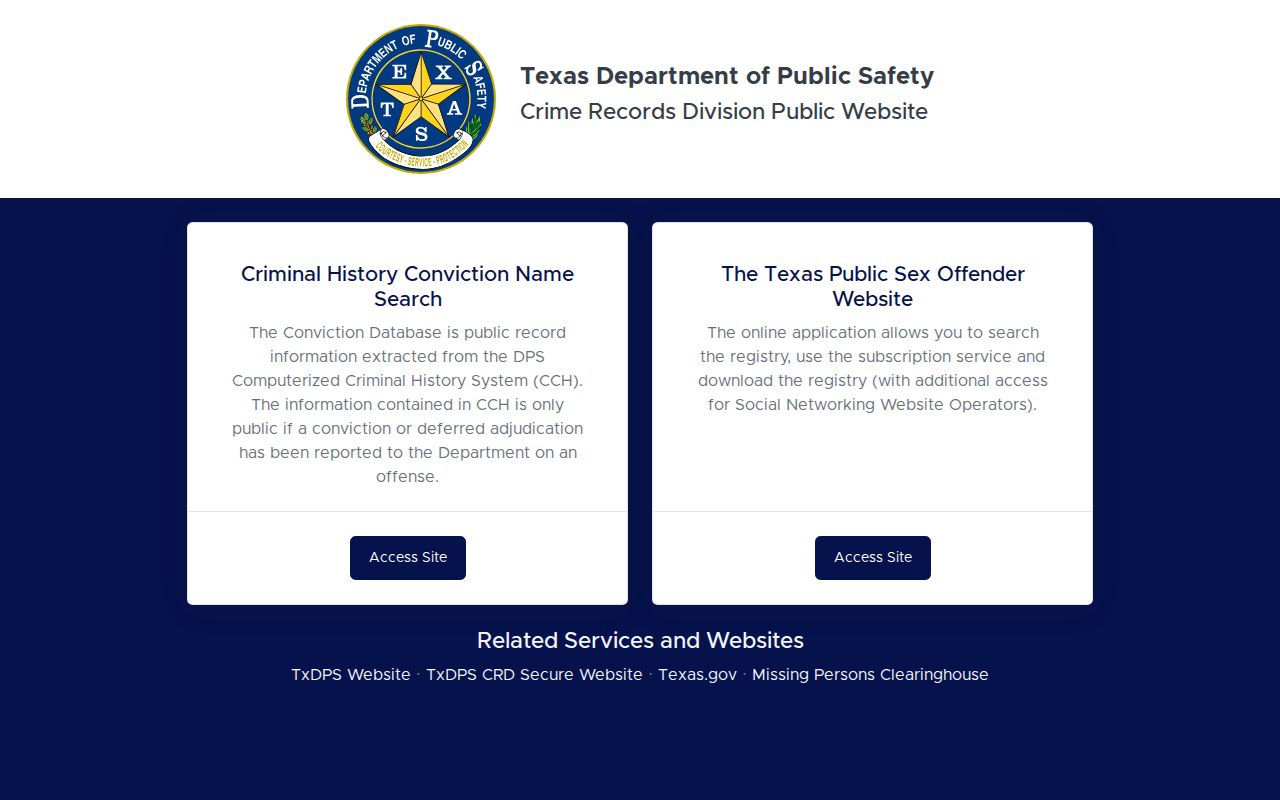
Last name and first name form the core query, with middle name, date of birth, sex, or race available where the portal exposes them. Better detail can narrow a match, but only fingerprints reliably connect a person to their own DPS-held history.
| Method | What it provides | Identity strength |
|---|---|---|
| DPS public name search | Public convictions and deferred adjudications reported to Texas | Name-based; verify every match |
| DPS personal review | The requester’s own record DPS is authorized to return | Fingerprint-linked |
| El Paso County court search | Local filed cases, including pending case detail | Case identifiers, not a statewide rap sheet |
To correct an apparent repository error, compare a DPS personal review with the certified El Paso County disposition. The clerk supplies the court result, and DPS provides the challenge process for its state record.
Types of Criminal Records in El Paso County
El Paso County criminal records begin at different points in the justice process. An incident report describes an allegation or investigation and may never lead to an arrest. A booking record proves a custody event, not guilt. A charging instrument shows what a prosecutor placed before a court, while the signed judgment records the result. DPS then connects fingerprinted arrest cycles with reported dispositions.
- Police and sheriff reports: the investigating agency holds the narrative, basic event facts, and releasable evidence details.
- Booking and jail records: El Paso County detention records intake, charges, bond, facility, release, or transfer.
- Court case files: the District Clerk keeps felony files and the County Clerk keeps Class A and B misdemeanor files.
- Warrant records: the issuing court and executing agency track the writ, status, and any bond terms.
- Supervision and registry records: CSCD, TDCJ, parole offices, and DPS keep distinct post-sentence or registration data.
Juvenile records are generally confidential. Grand-jury material can remain secret, and victim, medical, financial, or active-investigation details may be withheld. Public access never means that every field in an agency file must appear online.
El Paso County Justice Record Corridor
The Enrique Moreno County Courthouse at 500 E. San Antonio Avenue houses the District Clerk, County Clerk functions, district and county courts, District Attorney, and Public Defender. The Downtown Detention Facility sits close by at 601 E. Overland Avenue. A District Clerk counter on that facility’s first floor handles search-warrant filing. Sheriff operations, however, are east of downtown at 3850 Justice Street, and the Jail Annex is farther east on Montana Avenue.
The El Paso County Sheriff’s Office page identifies the agency that maintains county detention and sheriff-created records.
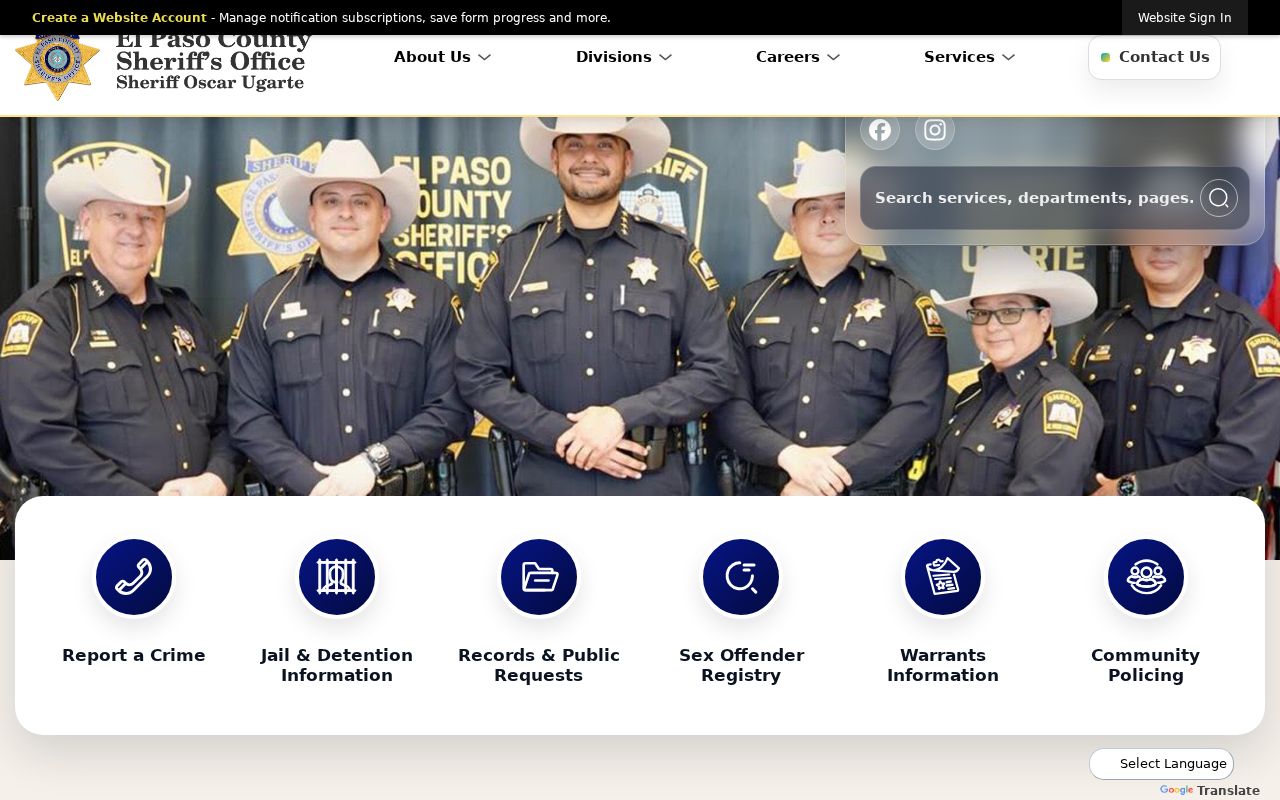
This geography matters. A sheriff counter cannot provide a District Clerk felony judgment, and a courthouse clerk does not own an EPPD incident narrative. Send each request to the office that made or legally maintains the record.
District Clerk Criminal Division
500 E. San Antonio Avenue
Felony case files and background checks
915-273-3534
County Clerk
500 E. San Antonio Avenue
Class A and B misdemeanor files
915-273-3532
Sheriff Headquarters
3850 Justice Street
Sheriff and detention routing
915-273-3800
What an El Paso County Criminal Record Shows
The fields depend on the source. A repository history is organized around biometric identity, arrest cycles, tracking numbers, court dispositions, sentences, and custody updates. An El Paso County case file follows one court matter through its docket. A booking profile centers on one confinement episode. Keep counts separate because one count may be dismissed while another ends in deferred adjudication or conviction.
| Name & Identifiers | Names, aliases, birth data when public, Texas SID or FBI number in authorized repository records |
|---|---|
| Arrest / Booking Data | Agency, date, booking number, fingerprint transaction, facility, and release or transfer |
| Charges & Statutes | Alleged or filed offense, count, statute, and felony or misdemeanor class |
| Disposition | Dismissal, acquittal, deferred adjudication, conviction, transfer, or another outcome |
| Sentence | Jail or prison term, fine, costs, restitution, or community supervision ordered by the court |
| Custody / Supervision | County jail, TDCJ transfer, probation entry, parole status, or discharge where public |
Disposed does not mean convicted. It only means the court treated the count as ended for docket purposes. Read the specific disposition and, when the outcome matters, obtain the signed judgment or order from the proper clerk.
El Paso County Record Custodians
El Paso County has no single public-information inbox for every elected office. The county Open Records page directs requests to the official who controls the requested material.
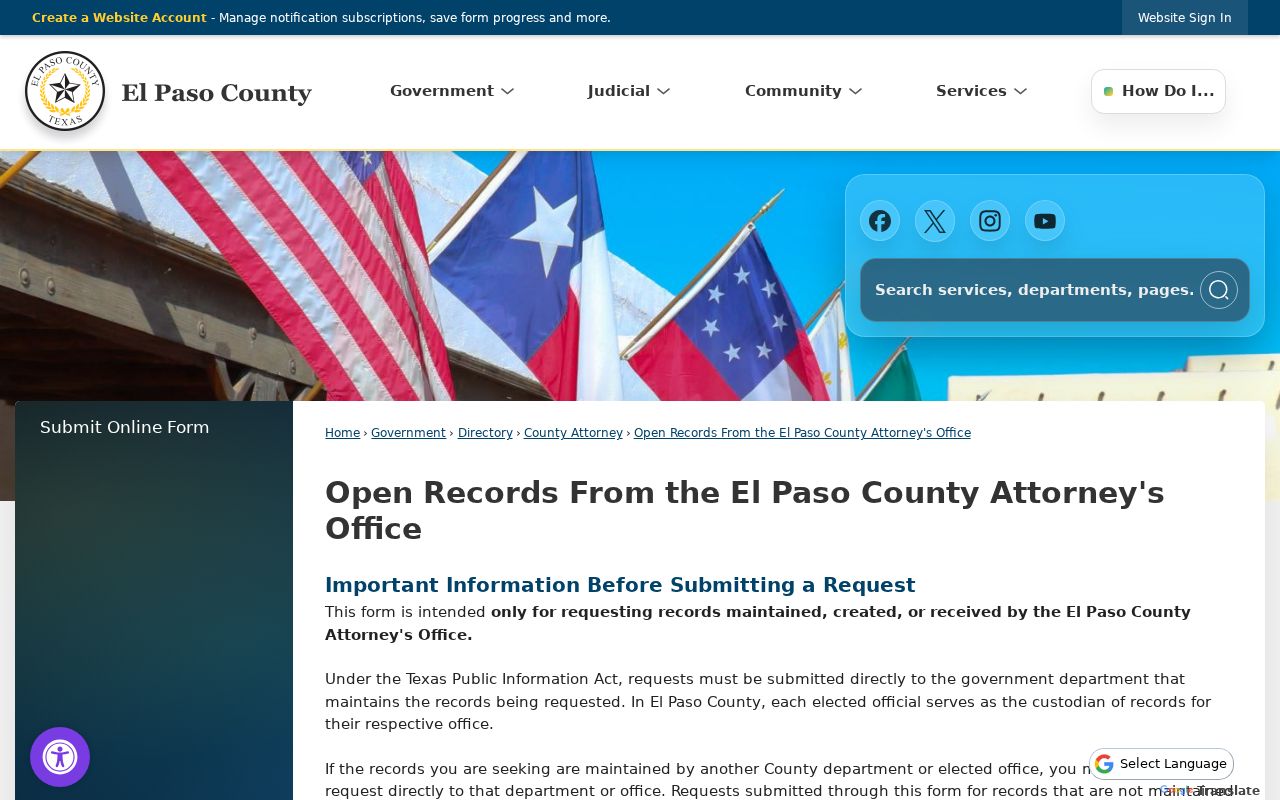
That rule prevents a common dead end. Send an EPSO patrol or booking request to the Sheriff, an EPPD report request to the City of El Paso, a felony file request to the District Clerk, and a misdemeanor file request to the County Clerk. The District Attorney has a separate channel for records held by that office.
A useful request states the event date and time, location, agency, report or case number, involved person, and desired format. Texas offices may charge under state cost rules after providing an estimate. No verified universal El Paso County sheriff report-copy fee was located, so ask the custodian for a written quote. An agency seeking an Attorney General ruling generally must request it within ten business days, but that deadline does not promise delivery in ten days.
Public Access Laws for El Paso County Criminal Records
The Texas Public Information Act begins with access to government information, but other laws and exceptions protect certain records. El Paso County agencies may redact personal identifiers, protected victim or juvenile details, medical data, and material whose release would interfere with an active case. Court files are presumptively open subject to statutes, court rules, sealing orders, and required redaction.
Key Texas laws:
Government Code §552.021 provides public access unless an exception or confidentiality law applies.
Government Code §552.108 covers specified law-enforcement and prosecutorial material, while basic arrest information receives different treatment.
Government Code §§411.083 and 411.135 govern confidential CHRI and the DPS public conviction product.
Code of Criminal Procedure Chapter 55A governs expunction after the 2025 recodification.
A requester ordinarily need not explain a purpose under the TPIA. That does not override confidentiality. Confirm any public name match through identifiers and the originating office before drawing a conclusion.
El Paso County Warrant Record Limits
The county Records Search hub links a Sheriff-issued Warrant Search with name fields. Results may include a warrant or case number, charge, issuing court, date, and bond. It is not statewide clearance. El Paso city citation warrants may appear in FullCourt, while Socorro and Horizon City bench warrants stay with their municipal courts. Justice-of-the-peace warrants require the issuing precinct. Sealed warrants and juvenile matters will not be exposed publicly.
If a possible warrant appears, contact the issuing court and confirm the case number, warrant type, and required action. Ask whether the court needs an appearance, payment, bond, or counsel filing. Keep the receipt or signed order and allow time for databases to update. Do not rely on broad web advice or walk into a law-enforcement office solely because a name matched. The right step depends on the exact writ and court.
County constables also serve process within seven precincts. Their involvement does not turn every warrant into an EPSO portal entry. The issuing court remains the key source for status and resolution.
Sealed, Expunged, and Restricted Records
Texas uses expunction for statutory removal or destruction of qualifying arrest records. Current provisions sit in Code of Criminal Procedure Chapter 55A, effective after the 2025 recodification. Possible routes include an acquittal, pardon or actual innocence, certain no-charge or dismissal outcomes after required waiting periods, and named diversion outcomes. Eligibility depends on the whole arrest episode. A dismissal alone does not guarantee relief.
An order of nondisclosure is different. It restricts ordinary public dissemination for eligible cases but does not destroy the record, and listed justice or authorized entities may retain access. Before filing in El Paso County, collect every charge, court outcome, arrest identifier, and agency tied to the episode. Obtain the clerk history and a DPS personal review, file in the correct court, follow service rules, retain certified orders, and recheck each named repository after processing.
| Expunction | Removes or destroys covered records when Chapter 55A eligibility and procedure are met |
|---|---|
| Nondisclosure | Limits public release but preserves authorized access under Government Code Chapter 411 |
| Routine restriction | Protects juvenile, victim, medical, financial, sealed, or active-case information without proving expunction |
El Paso County Custody and Parole Records
EPSO operates the Downtown Detention Facility and Jail Annex with a combined rated capacity of 2,906. The 2025 annual report recorded 20,352 bookings and 13,960 releases. Those are operational totals, not crime rates. A current-jail result can vanish after release or transfer even while the criminal case remains open. Search the court docket next. If the person received a state sentence, switch to the TDCJ Online Inmate Search.
The official TDCJ Region V parole directory identifies the two parole offices serving El Paso County.
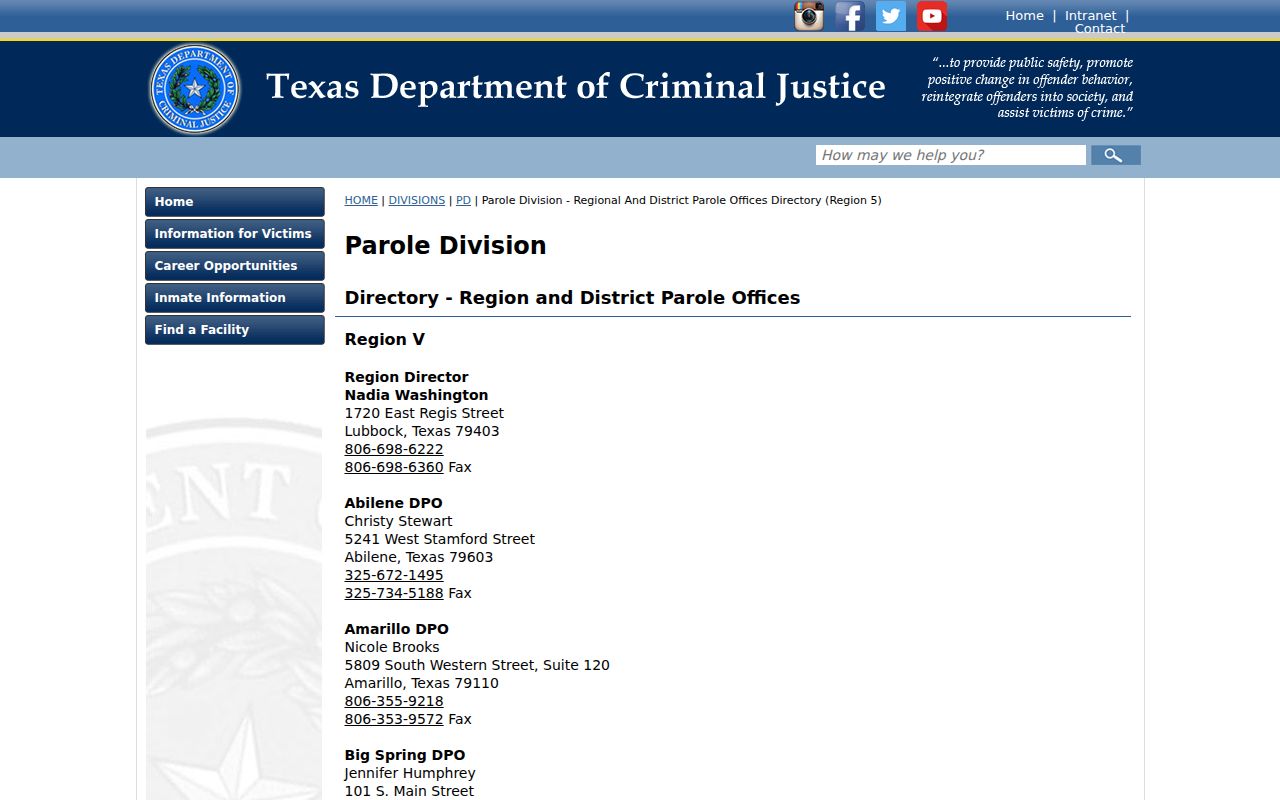
El Paso I is at 13 Founders Boulevard, and El Paso II is at 15581 Horizon Boulevard. The Texas Board of Pardons and Paroles makes release decisions, while the TDCJ Parole Division supervises release. El Paso County CSCD separately supervises court-ordered felony, misdemeanor, and deferred-adjudication community supervision. A sentencing judgment or filed revocation motion is the best public source for probation status; operational supervision notes are not presumed public.
Border Cases Beyond El Paso County Records
El Paso’s position on the Rio Grande, its ports of entry, Fort Bliss, and the Western District of Texas make jurisdiction especially important. A federal prosecution can arise from customs, immigration, firearms, narcotics, or federal-land authority and never appear in an El Paso County criminal case search. Search PACER for federal dockets in the Western District’s El Paso Division and use the federal clerk at 525 Magoffin Avenue when an official copy is needed.
Custody systems also split. The county jail covers EPSO detention, TDCJ covers state prisoners, and the federal Bureau of Prisons locator covers sentenced federal prisoners. An immigration detention record may use another federal channel. The Jail Annex stopped housing federal inmates in May 2024, so older custody patterns should not be projected onto current El Paso County jail data.
The practical rule is simple: identify the arresting authority and filing court first. That single fact often explains why a careful name search produces no county result.
Criminal Records by City in El Paso County
City police departments create their own incident and arrest reports, and municipal courts keep city ordinance and fine-only state-law cases. El Paso, Socorro, and Horizon City therefore add local records channels to the county system. Custodial arrests generally route to EPSO detention, while Class A and B misdemeanors and felonies move to county or district courts.
El Paso Criminal History
About 681,000 residents · EPPD reports and FullCourt municipal records
Socorro Criminal History
38,787 residents · SPD reports and Socorro Municipal Court records
Horizon City Criminal History
25,118 residents · local police, court, and Darrington counter channels
A city citation may never create a jail record. Conversely, a city arrest on a jailable charge may leave an EPSO booking and a county court file even when the municipal portal shows nothing. Start with the city agency, then follow the record to the legal custodian.