
How to Check Criminal History in El Paso
Begin with the event, not with a broad name search. Ask whether El Paso police wrote an incident report, issued a citation, or made a custodial arrest. Each act creates a different city record. A citation may stay entirely in Municipal Court, while a Class A or B misdemeanor moves to the El Paso County Clerk and a felony moves to the District Clerk. The Texas Department of Public Safety adds a statewide layer only after reportable data reaches its Criminal History Record Information system.
A complete El Paso record check uses the narrowest local source first, then moves outward:
- Request the incident or arrest narrative from the El Paso Police Department through the city public-information channel.
- Search El Paso Municipal Court when the event concerns a traffic citation, city ordinance, or fine-only Class C charge.
- Check the El Paso County current-jail search after a custodial arrest, keeping in mind that it shows current jailings only.
- Use the County Clerk for filed Class A or B misdemeanors and the District Clerk for filed felonies.
- Use the DPS conviction name search for reported statewide convictions or deferred adjudications, or the fingerprint personal-review process for your own DPS-held record.
Recent activity can take time to move between these systems. Confirm any possible match with date of birth, case number, court, filing date, and the originating office.
El Paso FullCourt Search Routes
El Paso Municipal Court offers three distinct routes in its FullCourt Public Access Portal. For a name search, choose Log In, Searches, Case Searches, By Party, then enter last name, first name, and date of birth. A citation search uses the citation number. A case search starts under Cases and Criminal, with the case number entered without dashes. Those routes are not interchangeable, so a failed name query does not end the search when a citation or case number is known.
The official FullCourt portal image shows how El Paso municipal criminal records are separated by search method.
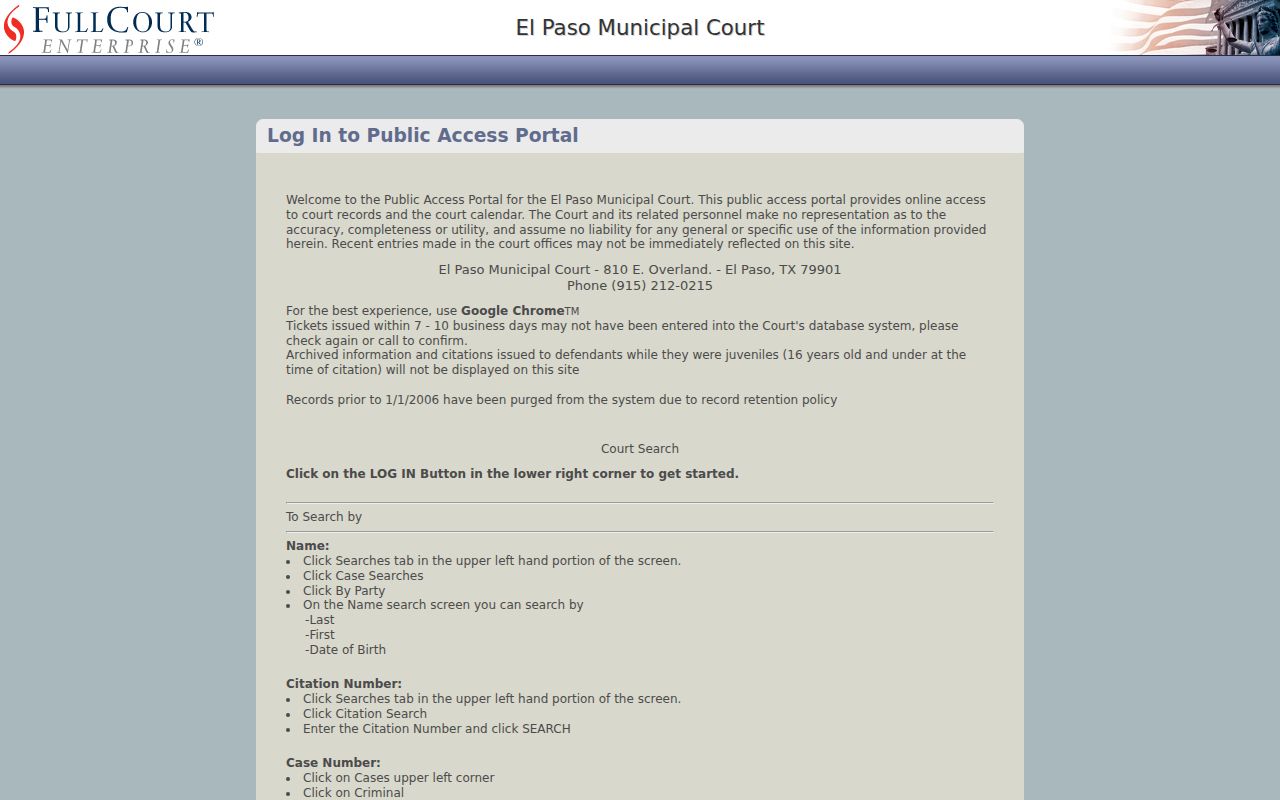
The screen is useful for locating city court entries, but it does not contain county misdemeanor, felony, jail, or DPS criminal history files.
Note: FullCourt says Chrome is preferred and warns that recent counter activity may not appear in the portal at once.
The El Paso Police Department
The El Paso Police Department creates reports for incidents investigated by its officers. Those files may include the date, time, place, report number, alleged offense, people or property involved, officer information, and a narrative. The report stays with EPPD even if El Paso County later books the person. Active-investigation material, protected victim or minor information, medical information, and confidential identifiers can be withheld or redacted under Texas law.
The city’s official police page provides the source view for the El Paso criminal records request route.

The department page identifies the city agency, while the public-information process supplies the durable way to ask for a report that no longer appears in a current custody search.
City Public Information
City Clerk and City Attorney channel
300 N. Campbell
El Paso, TX
915-212-0033
Weekdays, 8 a.m. to 5 p.m.
El Paso Citation Record Gaps
A recent El Paso citation can be real even when FullCourt shows no result. The city advises that a new ticket may take seven to ten business days to appear. A reader should preserve the citation number and search again after the entry window instead of treating the first blank screen as a dismissal. Counter activity may also lag in the public display.
Age and retention rules produce different gaps. El Paso records issued before January 1, 2006 were purged from this public system under the retention policy. Citations issued when the person was sixteen or younger do not display publicly, and archived information is also excluded. A pre-2006 absence is not an expunction, and a juvenile-display restriction is not proof that no citation existed. The correct fallback is the Municipal Court clerk, with the date, citation number, and nonconfidential identifying details ready.
Arrests and Bookings in El Paso
El Paso police own the arrest narrative, but the El Paso County Sheriff’s Office creates the booking and custody record when a person enters county detention. That second record can show a booking number, intake date, arresting agency, current charge labels, bond by count, facility, and present custody status. It does not prove guilt. The prosecutor may later change, reduce, add, or decline charges, and the court disposition may differ from the initial booking label.
Use the official county current-jail channel promptly because it is limited to current jailings. A name can disappear after release, transfer, sentence, or a portal update. For the fuller county-wide arrest process and every fallback channel, consult the contextual El Paso County arrest history resource. The city report remains with EPPD, so request it separately even when a county booking is visible.
El Paso arrest trail: EPPD incident or arrest report › EPSO booking and magistration › municipal or county court file.
Note: A citation and release may create an El Paso Municipal Court record without any county jail booking.
El Paso Report Request Choices
The El Paso City Clerk’s public-information channel routes requests to the office holding the city file. The form asks for requester contact information, a date range, and a detailed description. It offers electronic delivery, fax, pickup, regular mail, and certified mail. For an email search, it asks for an employee name or email plus a search word or phrase. Tight dates, the incident location, and the report or citation number help staff find the right criminal record and may reduce search cost.
The official City Clerk image shows where El Paso records requests begin.

That city channel is the proper fallback for EPPD material. Sending the same request to EPSO does not transfer custody of the city police narrative.
The form also includes a choice to accept lawful redactions. It warns that declining that choice may trigger an Attorney General decision process lasting at least forty-five days. Pickup and mail can carry charges, but the research did not locate a universal city report-copy fee. Request an estimate before choosing delivery.
El Paso Municipal Court Records
The El Paso Municipal Court is a court of record at 810 E. Overland. It handles city ordinance matters, traffic citations, and fine-only Class C offenses within its jurisdiction. Its file may show the citation or case number, filed allegation, settings, plea, warrant activity, judgment, and financial entries. It does not hold Class A or B misdemeanor prosecutions or felony cases.
The city’s Municipal Court image presents the official service point for El Paso citation and city-case records.

The court page and FullCourt work together: the page explains court services, while the portal supplies public case and calendar searches.
| Court Name | El Paso Municipal Court, a court of record |
|---|---|
| Case Types Heard | City ordinances, traffic citations, and fine-only Class C matters within city jurisdiction |
| Case Lookup Channel | FullCourt by party, citation number, or undashed criminal case number; clerk fallback when public display is unavailable |
| What the Docket Shows | Case or citation identity, settings, plea and disposition events, warrants, judgment, and financial entries when public |
| Copies & Fees | Request from the Municipal Court; confirm the current copy type, delivery method, and quoted charge before ordering |
El Paso Criminal Charge Boundaries
A court name reveals much about where the El Paso criminal record belongs. Municipal Court deals with fine-only city and Class C matters. The El Paso County Clerk holds filed Class A and B misdemeanors, which may carry county-jail exposure. The District Clerk Criminal Division holds felony files. A single police encounter can therefore begin at EPPD and produce a court record outside city government.
Do not infer the final charge from the arrest report. The officer’s allegation, jail booking description, prosecutor’s filed count, and signed judgment can differ for valid reasons. Read each count on the docket. “Disposed” only means the court has administratively concluded that item; it may reflect dismissal, acquittal, deferred adjudication, or conviction. When FullCourt has no document image or the charge moved above Class C, use the proper county clerk and request the filed charging instrument or judgment.
Where El Paso Records End Up
El Paso criminal records move by function rather than into one master city file. EPPD keeps the city report. EPSO keeps a county booking if custody occurred. Municipal Court keeps a qualifying city citation, while the county criminal records search routes higher filed charges to the County Clerk or District Clerk. The court then reports eligible disposition data to the Texas Department of Public Safety, where fingerprints and a transaction control number can associate the arrest cycle with a Texas SID.
Record flow: El Paso PD › El Paso County Courts › Texas Department of Public Safety.
That sequence explains why fresh El Paso criminal history details may appear locally before the DPS public product reflects them. It also explains why the paid DPS name search is not a copy of an EPPD report or a complete subject-authorized rap sheet. For an older event, verify the originating court disposition and use fingerprint-based personal review when certainty about your own state repository identity matters.
El Paso Criminal Records Downtown
Downtown geography mirrors the split in El Paso records. Municipal Court sits at 810 E. Overland. The Downtown Detention Facility is at 601 E. Overland, and the Enrique Moreno County Courthouse is at 500 E. San Antonio. These offices are close in space but do not keep the same file. A visitor seeking a Municipal Court citation, a current booking record, and a felony judgment could need three separate custodians.
Border-city activity adds another boundary. A federal prosecution in the Western District of Texas does not necessarily appear in FullCourt or the El Paso County portal. Fort Bliss, ports of entry, and federal jurisdiction can shift a criminal case into federal court records. Search the city system only for its scope, then follow the filing court shown by the event. This avoids the common mistake of treating a local blank result as a countywide, statewide, or federal clearance.
Note: Offices on Overland and San Antonio are nearby, but proximity does not merge their record custody or request rules.
Missing El Paso Criminal Records
When an expected El Paso record is missing, first identify the likely record type. For a police narrative, return to the city request channel. For a new citation, allow the stated entry delay and keep the citation number. For a custodial arrest, search the county current-jail portal, then call the appropriate clerk if release or CAPTCHA makes the result hard to confirm. A county court file may not exist until a prosecutor files a charge.
Next, test ordinary identity problems. Compare first and middle names, birth date when public, incident date, case number, and court. Do not combine two people solely because names match. If charge descriptions conflict, the filed instrument tells what was prosecuted and the signed order tells how each count ended. Ask for a plain or certified copy when a docket summary is not enough. A certified judgment and a city police report answer different questions, so request only the record that fits the need.
Public Access Rules
El Paso police and municipal court records start from a presumption of public access, but access is not absolute. The Texas Public Information Act permits requests to the city custodian without explaining an ordinary purpose. Law-enforcement exceptions can protect material that would interfere with an active case, and other law shields juvenile information, victim identities, medical details, account numbers, sealed material, expunged records, and information covered by an order of nondisclosure.
A public El Paso criminal history result should be treated with care. An arrest is not a conviction, a name match is not fingerprint identification, and a blank portal may reflect lag, retention, or restricted access. Verify the source record before relying on it.
Key Statutes:
Texas Government Code Chapter 552 establishes public access and exceptions under the Texas Public Information Act.
Texas Government Code Chapter 411 controls criminal-history dissemination and orders of nondisclosure.
Texas Code of Criminal Procedure Chapter 55A governs expunction of qualifying arrest records.