
Arrest History in El Paso County
El Paso County arrest events can begin with the Sheriff's Office, El Paso Police, Socorro Police, Horizon City Police, Texas DPS Highway Patrol, county constables, UTEP Police, or another agency with lawful authority. The arresting agency creates the incident or arrest narrative. If the person enters county detention, the El Paso County Sheriff's Office creates a booking and custody file. A magistrate then records warnings, probable cause, counsel, and bond decisions.
Prosecutors and courts create a different layer. A booking allegation can be declined, reduced, added to, or reorganized before filing. The County Clerk holds Class A and B misdemeanor cases, while the District Clerk holds felonies. Texas DPS may later associate a fingerprinted arrest cycle with a disposition. As a result, “arrest history” is a search across custodians, not a single El Paso County report, and none of these records alone proves guilt.
El Paso County Jail Search Is Current
The county's Jail Records gateway expressly describes its search as “current jailings only.” Search fields include last name, optional first name, and an exact booking or case number where offered. CAPTCHA can intervene. A result can show the booking number, intake date, arresting agency, charges, bond by count, court or warrant reference, facility, and current custody status.
A person disappears from the public jail search after release or transfer. That does not mean the arrest was expunged, the case ended, or the record was false. Search the county court docket for filing and bond events. Ask the arresting agency for its report. If a state sentence led to transfer, use the TDCJ locator. When the portal is slow or inaccessible, the county itself directs users to clerk contacts, making phone and counter channels part of the official fallback.
Note: Absence from the current roster cannot establish that no El Paso County arrest or prior booking exists.
How to Look Up El Paso County Arrests
Choose the source that answers the immediate question, then connect its identifier to the next record. A recent custody check starts at the jail roster. A narrative request goes to the agency that made the arrest. A court search is needed for filed charges and outcome. DPS and TDCJ serve narrower state roles and should not be treated as fresh-arrest logs.
- Search the El Paso County current-jail portal by surname, then narrow by first name or exact booking identifier.
- Identify the arresting agency. Request its incident or arrest report with the date, time, place, report number, and desired format.
- Search the County Clerk or District Clerk docket after filing, and call the correct clerk when CAPTCHA, lag, or a common name blocks a clear match.
- Use the Texas DPS public name search only for reported statewide conviction and deferred-adjudication data. For review of your own DPS-held record, follow the fingerprint personal-review process through IdentoGO instructions supplied by the authorizing channel.
- Check TDCJ after a state sentence or transfer. Submit a written Texas Public Information Act request to the actual record custodian when online sources lack the needed booking or report detail.
El Paso County Sheriff's Office
3850 Justice Street
El Paso, TX 79938
915-273-3800
Public Affairs: 915-273-3798. Confirm access hours before visiting.
Who Owns El Paso County Arrest Reports?
El Paso County has no single open-records inbox for every elected office or city. Each legal custodian handles its own material. An EPSO request cannot replace an EPPD incident report merely because the arrested person entered the county jail. El Paso Police records requests use the City's open-records form or portal. Socorro and Horizon City requests go through their official police or city channels. Texas DPS Highway Patrol and UTEP Police maintain their own agency records.
For EPSO material, identify the event date and time, place, agency, report or booking number, involved person, and preferred format. Sheriff Public Affairs publishes 915-273-3798 and epsheriffpio@epcountytx.gov. The formal county process is explained on the El Paso County Open Records page. Active investigations, juvenile information, victim identities, medical details, and confidential criminal-history content can be withheld or redacted under law.
The City of El Paso form allows electronic delivery, fax, pickup, regular mail, or certified mail. A focused date range and exact event details can reduce search work. Charges may apply, but the research found no current universal county fee for an EPSO report copy, so a requester should obtain an office estimate.
What an Arrest Record Shows
An arrest narrative and booking profile overlap, but each has fields the other may not. The agency report can describe the alleged event, legal authority, witnesses, property, evidence, transport, and officer. The detention record focuses on identity at intake, custody, charge validation, fingerprints, booking, bond, facility, and release or transfer. Sensitive identifiers and protected people are commonly redacted from public release.
| Booking Number | Links one El Paso County detention episode to custody and related case references. |
|---|---|
| Booking Date & Time | Records intake, not the date of conviction or final case action. |
| Arresting Agency | Identifies the office that holds the incident or arrest narrative. |
| Charges | Lists intake allegations by count; filed charges and final judgment may differ. |
| Bond | Shows type and amount by count where public; bond is not a fine or proof of guilt. |
| Booking Photo | Interface visibility can change. Request rules must be checked with the custodian; no photo is reproduced here. |
| Release Status | May show current custody, release, or transfer, but the live roster is not a history archive. |
El Paso County's Two Detention Facilities
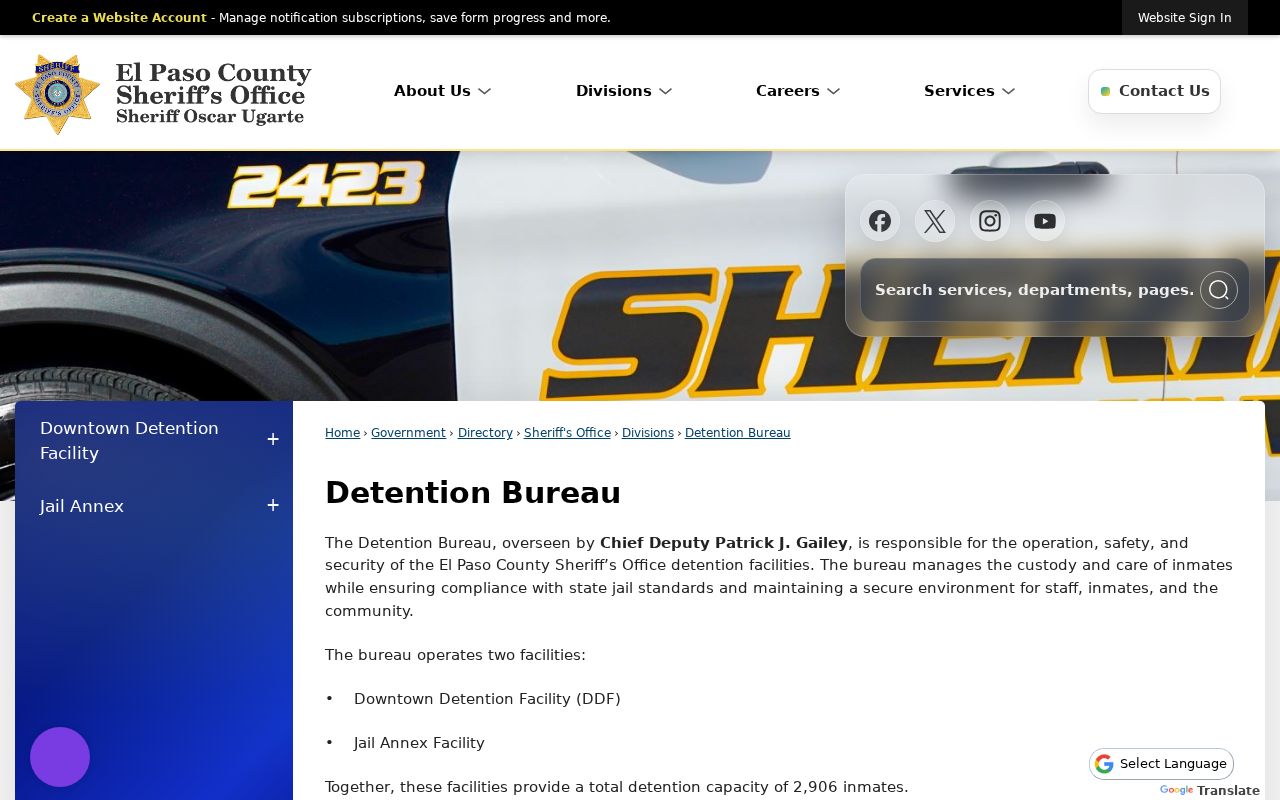
The El Paso County Sheriff's Office Detention Bureau runs the Downtown Detention Facility at 601 E. Overland Avenue and Jail Annex at 12501 E. Montana Avenue. The two sites have a combined rated capacity of 2,906. The Annex accounts for 1,896, including 1,872 housing beds and 24 ward or isolation beds. It has four housing units with four pods each. Downtown is closer to the courthouse and jail-magistrate workflow, while the Annex sits far east.
The official Detention Bureau overview presents both El Paso County facilities and their shared command.
A facility name describes where a person is held, not whether the filed charge is a felony or misdemeanor. Court level turns on the prosecutor's filing and the law. Movement between Downtown and the Annex can also occur without changing the underlying arrest record.
Recent Arrests and Booking Logs
El Paso County does not publish a complete historical arrest blotter through the jail portal. The public roster covers current custody. EPSO media releases describe selected incidents, not every arrest. For a recent event, search the current-jail screen first, allow for intake lag, and then request the arrest report from the proper agency. A citation and release may create no county booking at all, while a later court file may still exist in municipal or justice court.
The 2025 EPSO annual report offers aggregate context without identifying private people. It counted 20,352 bookings, down from 21,412 in 2024, and 13,960 releases, down from 17,131. Those are detention operations measures, not a crime rate and not a count of convictions. One person may have more than one intake, and the gap between bookings and releases cannot be used to infer case outcomes.
El Paso County Arrest Magistration Timeline
After transport, intake staff check identity, property, medical and safety needs, photograph and fingerprint the person, validate charges or warrants, and create the booking. The fingerprint transaction can help DPS connect the event to a Texas SID. The magistrate then addresses warnings, probable cause, appointed counsel, and release or bond conditions. Texas generally requires presentation without unnecessary delay and no later than 48 hours, with added probable-cause rules for warrantless arrests.
Record flow: Agency Report › EPSO Intake › Fingerprints and Booking › Magistration › Prosecutor Review › Clerk Case › Disposition Report to DPS
Magistration is not trial. A bond amount does not measure guilt, and separate counts may carry different terms. The prosecutor may decline the case or change the booking allegations before filing. For the legal result, read each count and signed order in the El Paso County criminal court case record.
Find El Paso County TDCJ Transfers
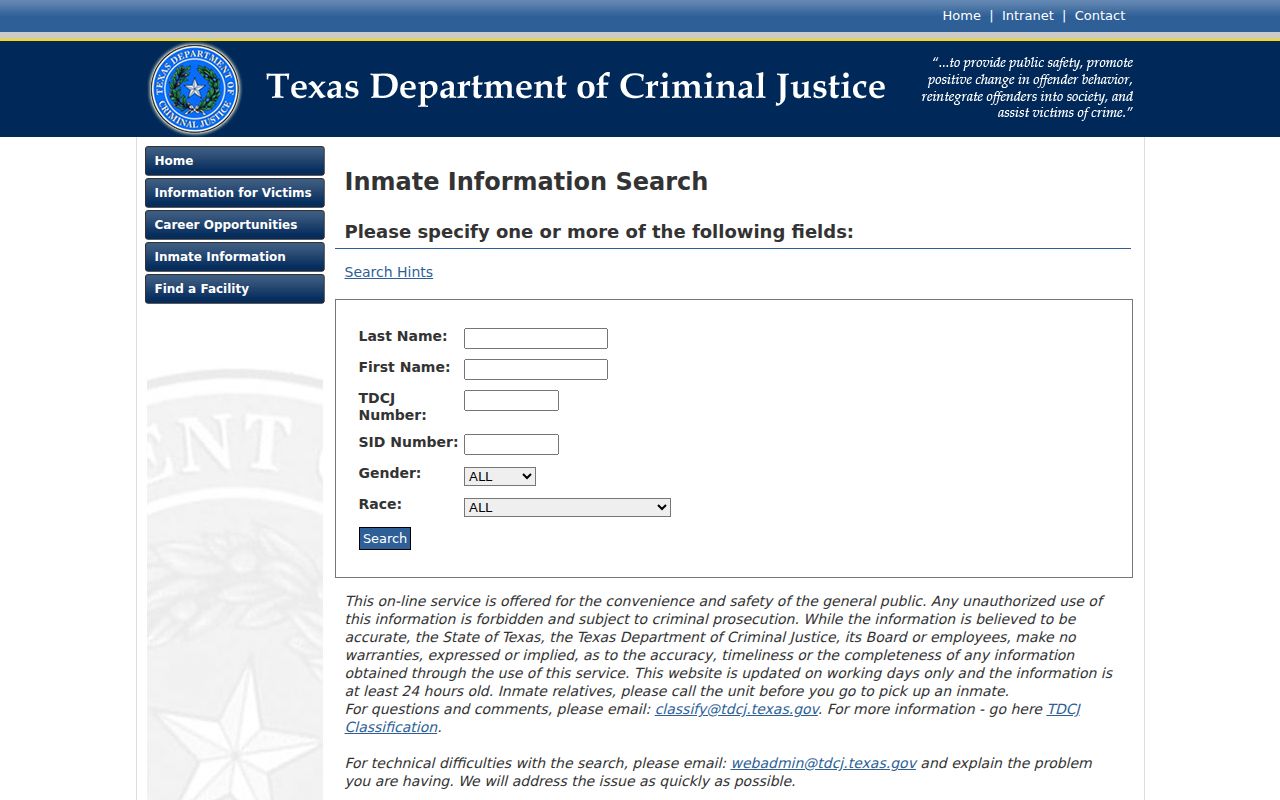
A jail name may disappear because the person moved to state custody after sentence. The TDCJ Online Inmate Search is the official next channel for a sentenced Texas prisoner. It is not an El Paso County jail archive. Search fields include last name, first name, TDCJ number, SID, sex, and race where offered. Strong identifiers help separate people with similar names.
The official TDCJ search screen shows the state locator's fields without displaying any individual El Paso County arrest result.
A TDCJ result can show state custody or parole-related information within that system. It does not supply the arresting officer's report or replace the El Paso County judgment. If the matter was federal, county and TDCJ searches may both be the wrong layer, and the official federal court or prison channel must be used.
Why El Paso County Booking Charges Change
The arresting officer's allegation, jail booking label, complaint, information, indictment, and judgment can differ without any database being defective. Police record the basis for arrest. Intake staff validate what supports custody. Prosecutors decide what can be filed. A grand jury may return a different felony count or no-bill it. The court then records pleas and the outcome. Keep every count separate when comparing the records.
A portal status such as “disposed” does not say whether the charge was dismissed, acquitted, deferred, or convicted. Nor does a release prove dismissal. Match the booking or case number where possible, check dates and court, and ask the clerk for the filed charge and signed judgment. For an apparent DPS error in your own record, compare a fingerprint personal review with the certified El Paso County disposition and follow DPS correction instructions.
Arrests vs Convictions
An arrest record documents an allegation, restraint, or booking event. A conviction record reflects a court judgment of guilt. El Paso County arrest material begins with the police or sheriff and may continue through detention even when no charge is filed. A conviction arises only after prosecution and court action. DPS's public name search is limited to reported convictions and deferred adjudications, so it is not a current arrest log or a complete fingerprint rap sheet.
| Arrest Record | Conviction Record |
|---|---|
| Created by the arresting agency and, after intake, EPSO detention. | Created through the court judgment and reported disposition. |
| Shows that an arrest or booking event occurred. | Shows a finding of guilt on a specific count. |
| Lives with the agency, jail, magistrate, and linked custodians. | Lives in the clerk file and may be reported to DPS. |
| May lead to release, no filing, dismissal, acquittal, deferred action, or conviction. | May lead to sentence, appeal, expunction only where law allows, or restricted disclosure. |
Note: An El Paso County arrest is not proof of guilt, and a booking charge may never become the court's filed charge.